Plan an Anganwadi learning kit with literacy, numeracy, play, books, art and storage. Compare materials and prepare an itemised institutional procurement scope.
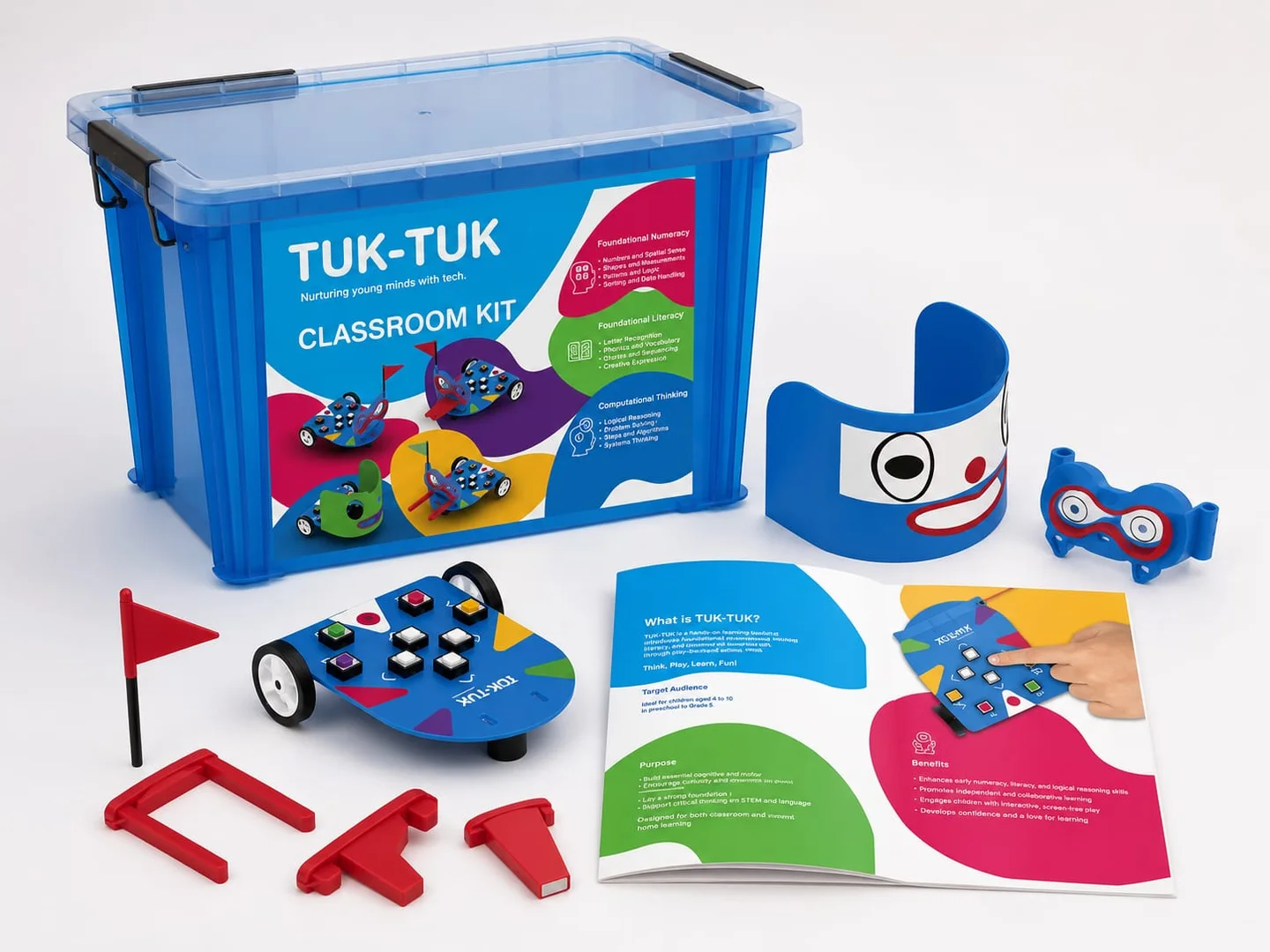
Existing TUK-TUK classroom-kit photograph. Confirm the current package contents in the written quotation.
Overview
An Anganwadi kit is a selected collection of teaching-learning, play, literacy, numeracy and creative materials for early childhood care and education (ECCE). It is a procurement description, not one universal mandatory package. Start with the children, language, activities and centre space; then select materials and quantities. An FLN kit focuses on foundational language and number experiences, while a wider centre kit may include books, pretend play, art supplies, storage and separately scoped classroom items.
What should an Anganwadi learning kit include?
A useful kit covers activities rather than simply filling a box. Map each proposed item to a learning experience and the facilitator who will use it. The groups below are a planning checklist, not a guarantee that all items are included in a particular product.
Literacy and oral language
Picture books, familiar story prompts and conversation cards can support listening, vocabulary and expression. Choose scripts and pictures meaningful to the children; check whether materials are readable and usable by the facilitator.
Numeracy
Counting objects, sorting resources and shape or pattern materials can support comparison, grouping, quantity and spatial language. Prefer experiences children can explain, not only number labels to memorise.
Cognitive and manipulative play
Blocks, puzzles and matching materials invite children to plan, try alternatives and work with their hands. Check part sizes, complexity, ease of cleaning and the current age guidance for each item.
Pretend play and local life
Dolls and role-play resources can support conversation, cooperation and familiar routines. Reflect local life respectfully and offer varied roles rather than limiting who can use a material.
Art and creative expression
Select suitable drawing, mark-making and craft materials with supervision and replenishment in mind. Provide time for children's own expression rather than expecting identical finished work.
Books and storytelling
Use accessible picture books, repeated stories and child-led retelling. Plan where books will be stored, how they will circulate and who will read aloud; a supplied book is useful only when it is used.
Separate learning materials from the wider centre scope
Outdoor movement equipment, health or hygiene items and furniture may be part of a wider approved centre project, but they are not automatically part of an FLN kit. Specify each separately, including installation, supervision and maintenance responsibilities. Verify available catalogue items and the applicable project requirements before requesting a bundled quotation.
Choose by age, participation and material suitability
Start with a task the children can attempt with adult support. Reduce the number of objects or instructions for a simpler activity and add a comparison or explanation for a more challenging one. Product age guidance and safety documents still apply; adapting the task does not make unsuitable components safe. Ask for information on small parts, edges, finish, cleaning, care and any applicable test documentation for the actual variant.
Storage and classroom organisation
Plan reachable, labelled storage so the facilitator can locate a complete activity set, use it and return it. Count parts during handover and keep a simple inventory with missing or damaged items noted. Separate resources needing adult handling from everyday accessible materials. Include dry storage, cleaning time and replenishment in the project plan rather than treating the supplied box as the full storage solution.
TLM, FLN kit and ECCE kit: what is the difference?
These terms overlap but describe different planning emphases. Use the learning goal and itemised contents to compare proposals, not the label alone.
Term
Planning emphasis
TLM
Teaching-learning materials: resources supporting interaction, exploration and activities.
FLN kit
Materials selected mainly for foundational language and number experiences.
ECCE kit
A wider early-childhood activity scope including play, expression and participation.
Robot kit
An optional movement-and-sequencing aid such as TUK-TUK, with facilitator-guided activities.
Institutional and CSR procurement checklist
Write a centre-wise scope before comparing quotations. State the child and facilitator context, delivery locations and approved budget, then request a bill of materials with quantities and variants. A photograph illustrates the product; it is not the acceptance specification.
List learning goals, centre counts, space and language needs.
Select materials and confirm age, care and safety information.
Request a sample or demonstration and an itemised quotation.
Agree supply, taxes, delivery, orientation and replacement terms in writing.
Check quantities and condition at handover; record gaps and responsible contacts.
Review classroom use before scaling the same bundle to other centres.
Plan a project-specific bundle
Smart Anganwadi's existing catalogue covers multiple learning corners and centre resources. A funded institutional project can request a combination around its approved scope. TUK-TUK can be considered where physical route-planning activities are useful; it is not a mandatory element of every kit. Discuss local-language use, facilitator orientation and replenishment requirements before finalising the bundle.
Do not assume a universal product package. Follow the applicable programme or procurement specification and select age-appropriate materials for the centre's approved scope.
Can a robot replace the complete learning kit?
No. A robot activity is one possible aid. Children also need stories, conversation, manipulatives, expression and varied play experiences.
How are quantities decided?
Use centre count, activity format, number of children taking turns, storage and replenishment needs to prepare an itemised scope. Confirm quantities in the quotation.
Educational context
Official guidance provides educational context, not approval or certification of this product.
Request a demonstration, current itemised contents and a written project quotation. Smart Anganwadi supplies and implements funded projects; it does not provide grants.
These are separate catalogue items, not the contents of a universal kit. Check the selected variant, age guidance and written quotation. Availability and commercial terms remain on each product's own page.
Smart Anganwadi™ is a tech-enabled Anganwadi implementation and execution partner operated by Arihant Enterprises, Thaltej, Ahmedabad, Gujarat 380058, India | info@smartanganwadi.com | +91 99982 43365. It is a private company, not a government department or scheme, and does not provide grants, funding, loans or any assistance or government financial support.