Anganwadi Robot Kit for Screen-Free FLN & Play-Based Learning
Plan teacher-guided robot activities for Anganwadi and Balvatika: session flow, counting, direction, storytelling, group roles and TUK-TUK implementation.
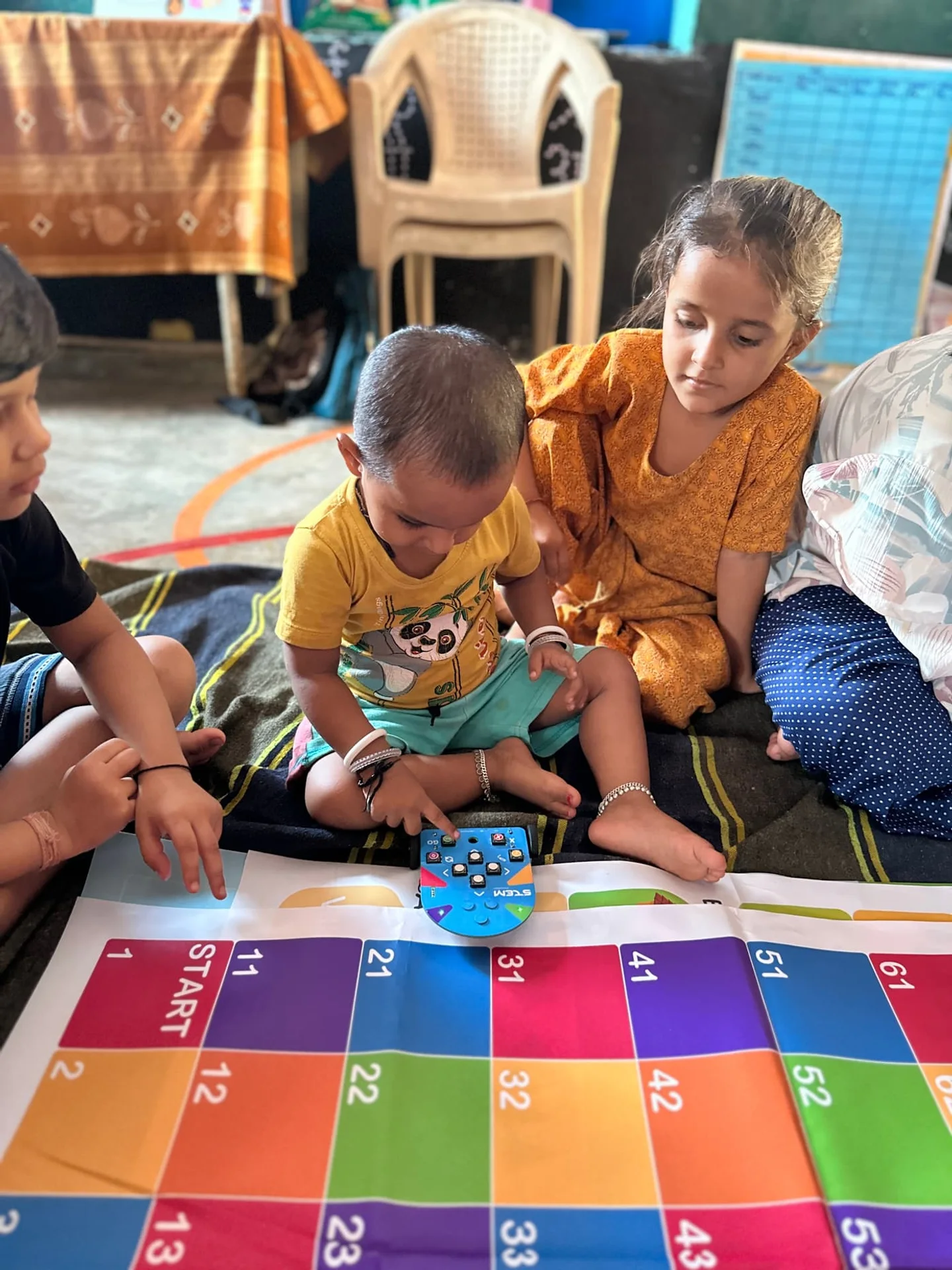
Existing learning-session photograph showing a numbered mat and hands-on robot interaction. No location or outcome is inferred from the photograph.
Overview
An Anganwadi robot kit combines a suitable educational robot with physical activity materials and teacher-guided play. The useful classroom experience is not simply watching a robot move: children identify a goal, arrange directions, predict a result and explain or revise their plan. Screen-free button-based systems such as TUK-TUK make that sequence visible on an activity mat. The choice remains optional and must suit the current product guidance, learner needs and available supervision.
Why consider robotics in early childhood learning?
A moving robot can provide a concrete result for a child's plan. Ask children to explain where it should go, test their idea and describe the difference between prediction and result. This offers a context for talk, counting and problem-solving; it does not establish that robotics is necessary or more effective than other teaching aids.
What coding means in an Anganwadi session
Here, coding means ordering simple directions and testing what follows. Children can use words, gestures or physical controls to describe a plan. Computational thinking includes sequencing, prediction and changing a step after observing a result. It is not a professional programming course, and a longer sequence is not automatically a better activity.
A sample teacher-guided session
The following is a suggested planning sequence, not a fixed prescribed lesson or time requirement. Check the selected robot's instructions, mat and supervision guidance before adapting it.
Prepare: clear the movement area, check the equipment and choose a familiar target.
Introduce: talk about the target and invite children to describe its position.
Predict: agree a short sequence and ask what the robot might do.
Try: one child operates the controls with facilitator support while others observe.
Reflect: compare the route with the plan; count, describe or correct as appropriate.
Rotate: give another child a meaningful role and change only one part of the challenge.
Close: let children explain what they noticed, then check and store the materials.
Four ways to connect movement to FLN
Choose one learning focus per activity and use compatible printed targets or teacher-prepared prompts. Do not assume the robot recognises letters, pictures or speech: it follows the movement instructions entered by the operator.
Literacy: describe a pictured target
Where suitable pictures are available, ask a child to name and describe one. Another child identifies it and proposes a route. Listen for meaningful vocabulary and an understandable description, not only arrival at the picture.
Numeracy: count each move
Choose a short route and count movement steps aloud. Compare a prediction with the actual journey. Keep move-counting separate from the number printed on the destination; they represent different quantities.
Spatial thinking: explain directions
Use a shared starting position and practise words such as forward, turn and beside. Allow children to point or gesture first. Discuss whose viewpoint is being used when a direction seems ambiguous.
Storytelling: agree the order
Use appropriate story pictures to agree two events or stops. Children explain why one comes before another, plan the route and retell what happened. The educator supplies the story context rather than claiming the robot generates it.
The Teacher/AWW role in group learning
The facilitator prepares suitable materials, demonstrates safe handling, asks open questions and gives children time to respond. Rotate operator, planner, predictor and storyteller roles instead of creating a queue in which most children only watch. Offer pointing, gesturing and partner responses when helpful. Stop or simplify a task if handling, space or attention makes meaningful participation difficult.
Observe learning, not just successful movement
Record what a child said or did against the chosen goal: counted moves, named a target, used a direction word or explained a changed instruction. Also note the support needed. Do not turn enthusiasm, attendance or a completed route into an unsupported learning-impact percentage. Use observations to choose the next activity, not to label children.
TUK-TUK as a Smart Anganwadi implementation option
TUK-TUK's physical buttons and activity-mat format fit the planning-and-testing model described here. Existing product photographs show packaged and classroom presentations. See the dedicated product page for the interaction format and current enquiry options; request the selected variant's itemised contents, age guidance, care instructions and support scope rather than treating every pictured accessory as included.
Start with a demonstration in the intended space. Check mat visibility, the number of meaningful turns, facilitator confidence, storage and equipment care. Agree orientation, maintenance contacts and handover records in the procurement scope. A successful demonstration is useful planning evidence, but it is not by itself proof of improved literacy or numeracy outcomes.
Does the robot recognise the pictures on a mat?
The described TUK-TUK model uses entered movement directions. The facilitator and children identify targets; no automatic picture recognition or artificial-intelligence capability is claimed.
How many children can participate?
Use a small group with meaningful rotating roles. Confirm the suitable format for the current kit, available space, supervision and learner needs; no fixed capacity is established here.
Is a robot required for preschool computational thinking?
No. Sequencing and prediction can also be practised with stories, movement, blocks and picture cards. A robot is one optional way to make an instruction sequence visible.
Educational context
Official guidance provides educational context, not approval or certification of this product.
Request a demonstration, current itemised contents and a written project quotation. Smart Anganwadi supplies and implements funded projects; it does not provide grants.
Smart Anganwadi™ is a tech-enabled Anganwadi implementation and execution partner operated by Arihant Enterprises, Thaltej, Ahmedabad, Gujarat 380058, India | info@smartanganwadi.com | +91 99982 43365. It is a private company, not a government department or scheme, and does not provide grants, funding, loans or any assistance or government financial support.