
What Is an FLN Kit? A Practical Guide for Anganwadi and Preschool
What is an FLN kit? Explore literacy and numeracy materials, example activities, robot-kit differences and a practical Anganwadi procurement checklist.
By Smart Anganwadi™ · Published · Updated
Overview
An FLN kit is a collection of materials selected to support Foundational Literacy and Numeracy activities. For Anganwadi and preschool settings, that means rich oral language, stories, symbols, counting, quantity, shapes and patterns through play and interaction. A kit is a resource for an educator, not a complete curriculum or a promise of learning outcomes. Judge a proposal by what children can do with the materials and how the facilitator will use them.
What is inside an FLN kit?
FLN stands for Foundational Literacy and Numeracy. Typical teaching-learning materials include books, picture or letter cards, counting objects, number cards, sorting resources, shapes and activity prompts. There is no single contents list shared by every supplier or programme. The examples below explain what to look for, not a promise that all these items are supplied in one Smart Anganwadi package.
| Material group | Examples to consider | A facilitator-guided activity |
|---|---|---|
| Oral language and literacy | Picture books, story cards, familiar-object pictures and suitable letter cards. | Describe a picture, retell a short story or match a spoken prompt to a visible symbol. |
| Counting and quantity | Counting manipulatives, counters and number cards. | Match one spoken number to each object, compare two groups and explain which has more. |
| Shapes, sorting and patterns | Shape sets, puzzles and resources with different colours or sizes. | Sort by one property, build a repeat and describe the rule. |
| Expression and participation | Puppets, suitable mark-making resources and conversation prompts. | Take turns in a story or explain a drawing using familiar words. |
| Optional robot activities | A screen-free robot, compatible mat and optional supported drawing attachment. | Predict a route in Grid Mode or describe marks made in Draw Mode. |
| Facilitator support | Activity instructions, an inventory and agreed orientation. | Set up, adapt and store an activity so it can be repeated reliably. |
FLN kit vs FLN robot kit: which do you need?
An FLN kit is the broader collection of language and number resources. An FLN robot kit is one specialised activity format within that collection, using physical instructions and movement to make sequencing concrete. Choose books and manipulatives for shared reading, sorting and open-ended exploration; add a robot where route prediction, counting movement or drawing patterns fits the plan. A centre can combine the two without replacing everyday play and conversation.
Start with language and number experiences
For language, choose familiar pictures, books and prompts that invite conversation rather than only repetition. For numeracy, provide opportunities to handle, count, compare, sort and describe objects. A label such as alphabet kit or maths kit does not show whether the material supports an appropriate activity. Ask the supplier to demonstrate the actual task with the intended age group and language in mind.
Example: one resource, two distinct goals
A picture-and-route activity can begin with children describing a familiar object, with the goal of using understandable vocabulary. In a separate turn, the same layout can be used to count movement steps. Keep the goals distinct: reaching the correct picture does not prove reading fluency, and a destination numbered five does not mean the journey contained five moves. Ask children to explain what they did so the learning connection is visible.
Questions to ask about the contents
Request a list showing each item, quantity, variant and intended use. Check language, part sizes, supervision, cleaning, storage and replacement arrangements. Confirm which resources are reusable and which need replenishment. A product photo may show optional accessories or an earlier version; the written specification should say what the centre will actually receive.
- Which language and number goals does each item support?
- Can children use the materials in more than one activity?
- What age and safety instructions apply to each component?
- What guide or demonstration helps the facilitator get started?
- What is included, optional or supplied separately?
- How will parts be checked, stored and replaced?
Where does a screen-free robot fit?
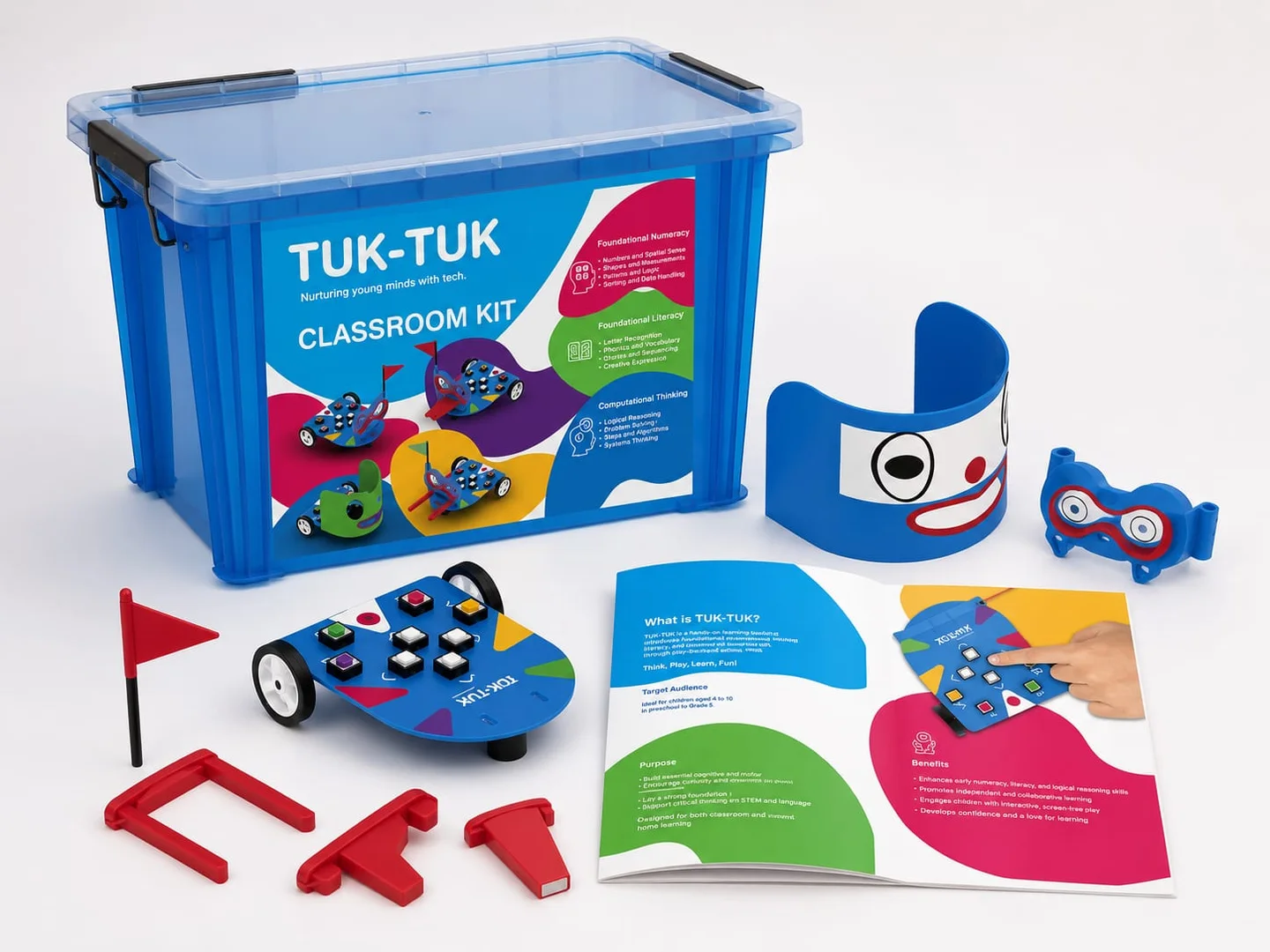
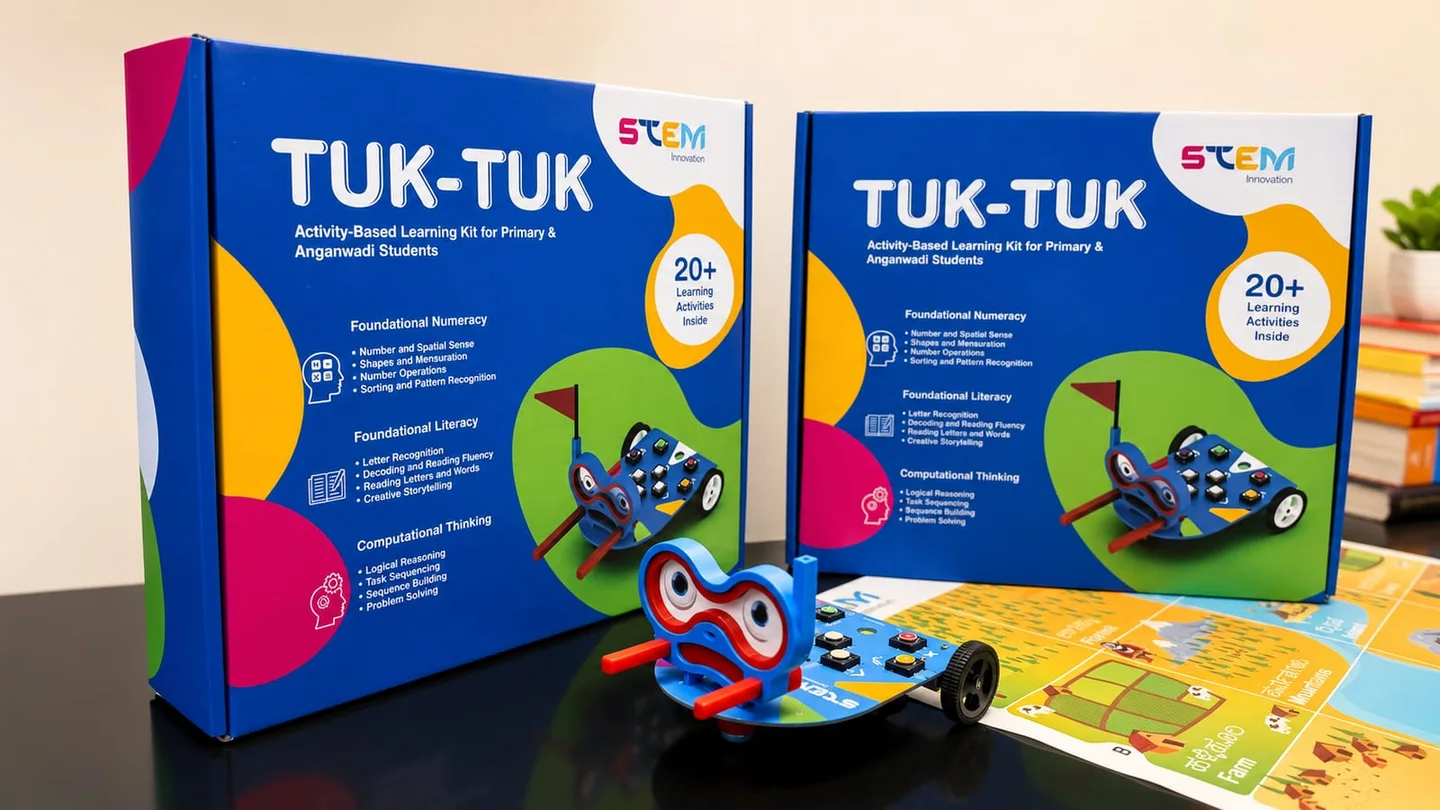
TUK-TUK provides a physical direction-and-sequence activity format. An educator can connect a route challenge to talk, counting or recognising appropriate targets. It remains one optional aid in an FLN plan; it does not replace books, free play or a trained facilitator. Its existing product photographs illustrate the robot and packaging, but a project should still obtain the current contents and support specification.
From demonstration to a usable centre order
During a demonstration, note whether the facilitator can set up the task, children can see and handle the materials appropriately, and the activity leads to explanation rather than only a performance. Try a simpler prompt and a more challenging one. After the demonstration, record the agreed contents, delivery, orientation and care responsibilities in the quotation. Review classroom use before ordering the same package for additional centres.
A kit label is not an approval
Official foundational-stage guidance provides educational context; it does not endorse every product using the term FLN. Map planned activities to the relevant learning goals and local programme requirements without claiming government certification or full curriculum compliance. For a wider procurement brief, use the Anganwadi kit guide and the existing teaching-learning material guide.
What is the full form of FLN?
FLN stands for Foundational Literacy and Numeracy: foundational language, reading-related and number skills. In early childhood, activities include conversation, stories, symbols, counting, quantity, shapes and patterns through guided play.
Is every FLN kit suitable for every age group?
No. An Anganwadi or preschool activity and a kit for primary grades may differ in symbols, task difficulty, part sizes and facilitator guidance. Match the actual components to the learners and follow the current variant's age and safety instructions.
How much does an FLN kit cost?
Price depends on the selected materials, quantities, robot or non-robot format, orientation and delivery scope. Request an itemised current quotation rather than comparing packages by the FLN label alone.
Can Smart Anganwadi supply an institutional FLN kit?
Use the product catalogue and project enquiry to discuss the centre count, location, learning goals and materials. Confirm the exact variant, quantities, languages, delivery and support in the accepted written quotation.
Educational context
Official guidance provides educational context, not approval or certification of this product.
- NCERT: National Curriculum Framework for the Foundational Stage (2022)
- Ministry of Education: NIPUN Bharat guidelines
Related learning guides
Planning an FLN or Anganwadi learning project?
Request a demonstration, current itemised contents and a written project quotation. Smart Anganwadi supplies and implements funded projects; it does not provide grants.
Request a Demo · Request Product Details
Smart Anganwadi™ is a tech-enabled Anganwadi implementation and execution partner operated by Arihantya Vision Works Private Limited, Thaltej, Ahmedabad, Gujarat 380058, India | info@smartanganwadi.com | +91 99982 43365. It is a private company, not a government department or scheme, and does not provide grants, funding, loans or any assistance or government financial support.