
FLN Activities for Anganwadi: Literacy, Numeracy and Movement
Plan facilitator-guided FLN activities using conversation, counting, direction and storytelling, with prompts, adaptations and simple observation examples.
By Smart Anganwadi™ · Published
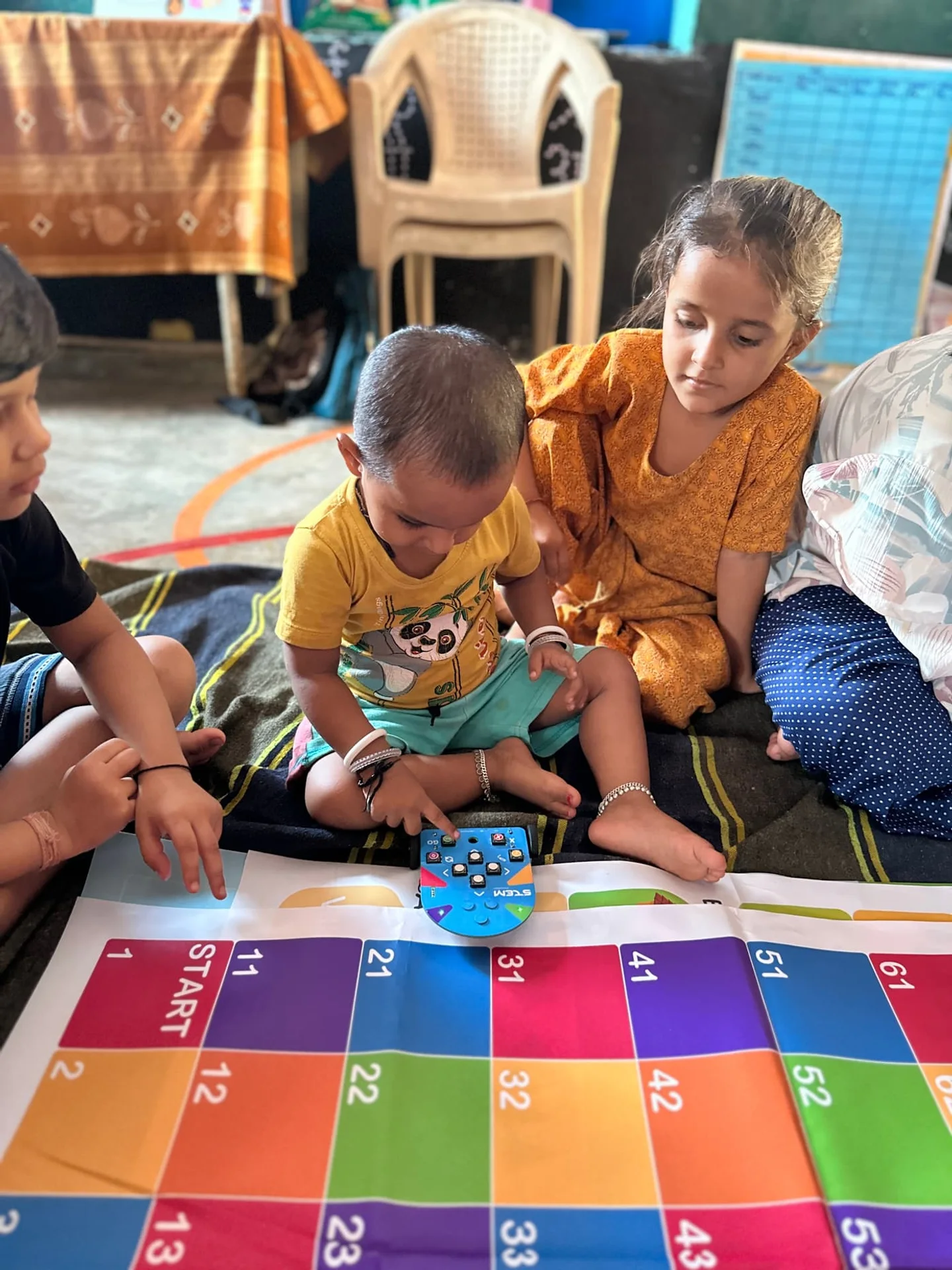
Overview
An FLN activity for an Anganwadi should give children something meaningful to say, notice, count, compare or explain. Start with one language or number goal, choose suitable materials and invite participation through play. A short guided task can use picture cards, everyday objects, movement or a compatible robot mat. The examples below are planning suggestions, not a prescribed government lesson plan or validated impact programme.
Literacy: talk about a familiar picture
Choose a picture children understand. Ask them to name what they see, describe one detail and connect it to something familiar. A partner can identify the picture from a description. Listen for meaningful words and understandable expression rather than insisting on one scripted answer. Where suitable TUK-TUK picture materials are available, reaching the target can follow the conversation; movement should not replace the language activity.
Numeracy: connect counting with visible action
Use objects, claps or a short movement route so children can match one number word to one action. Ask how many actions they predict, then count together and compare. With a robot, count movement steps rather than assuming a printed destination number equals the distance. Reduce the route length for a simpler task; for another turn, ask children to explain a different route.
Movement: practise spatial language
Start from a shared position and use clear words such as forward, beside or turn. Let children demonstrate or point before describing a route orally. Discuss different viewpoints if left and right become confusing. Use compatible robot controls only after the group understands the starting position; follow the equipment instructions and leave an appropriate clear movement area.
Storytelling: agree what happens first
Select two or three familiar picture events and ask children to arrange and explain them. Accept plausible alternatives when children can give a reason. Retell the story with a beginning and an ending. A suitable robot route can visit picture stops after the story order is agreed. The facilitator creates the narrative context; do not claim the robot understands or generates stories.
Adapt the challenge without excluding children
Offer a smaller choice of targets, a shorter sequence or a partner response when needed. Provide predictor, speaker, pointer and observer roles as well as operator turns. Children can participate meaningfully without all giving the same response. Match materials and handling to current product guidance and individual support needs; simpler instructions do not make unsuitable parts safe.
Record what children actually do
A useful note might say that a child counted three moves with prompts or described the target using a position word. Include the support given and what to try next. Avoid converting participation into a percentage improvement or treating one completed task as a reading assessment. These observations guide activity planning and are not a substitute for the programme's assessment process.
| Activity goal | Example observation | Next planning step |
|---|---|---|
| Count moves | Counted each move with the group. | Try a short route with less prompting. |
| Describe a target | Used a familiar object name and pointed to its position. | Model one additional position word. |
| Explain a change | Noticed the turn was different from the plan. | Ask which instruction could be changed. |
Select the aid after choosing the goal
Use the simplest suitable material for the intended experience. Books and picture cards may be enough for a story task; a robot can make route prediction concrete. TUK-TUK's activity examples show one possible button-and-mat format. Confirm the actual mat symbols and package contents before planning sessions around them.
Educational context
Official guidance provides educational context, not approval or certification of this product.
- NCERT: National Curriculum Framework for the Foundational Stage (2022)
- Ministry of Education: NIPUN Bharat guidelines
Related learning guides
Planning an FLN or Anganwadi learning project?
Request a demonstration, current itemised contents and a written project quotation. Smart Anganwadi supplies and implements funded projects; it does not provide grants.
Request a Demo · Request Product Details
Smart Anganwadi™ is a tech-enabled Anganwadi implementation and execution partner operated by Arihant Enterprises, Thaltej, Ahmedabad, Gujarat 380058, India | info@smartanganwadi.com | +91 99982 43365. It is a private company, not a government department or scheme, and does not provide grants, funding, loans or any assistance or government financial support.