
How Computational Thinking Can Be Introduced Through Play in Early Childhood
Explore sequencing, prediction, direction and problem-solving through stories, movement and physical robot activities, without professional programming claims.
By Smart Anganwadi™ · Published
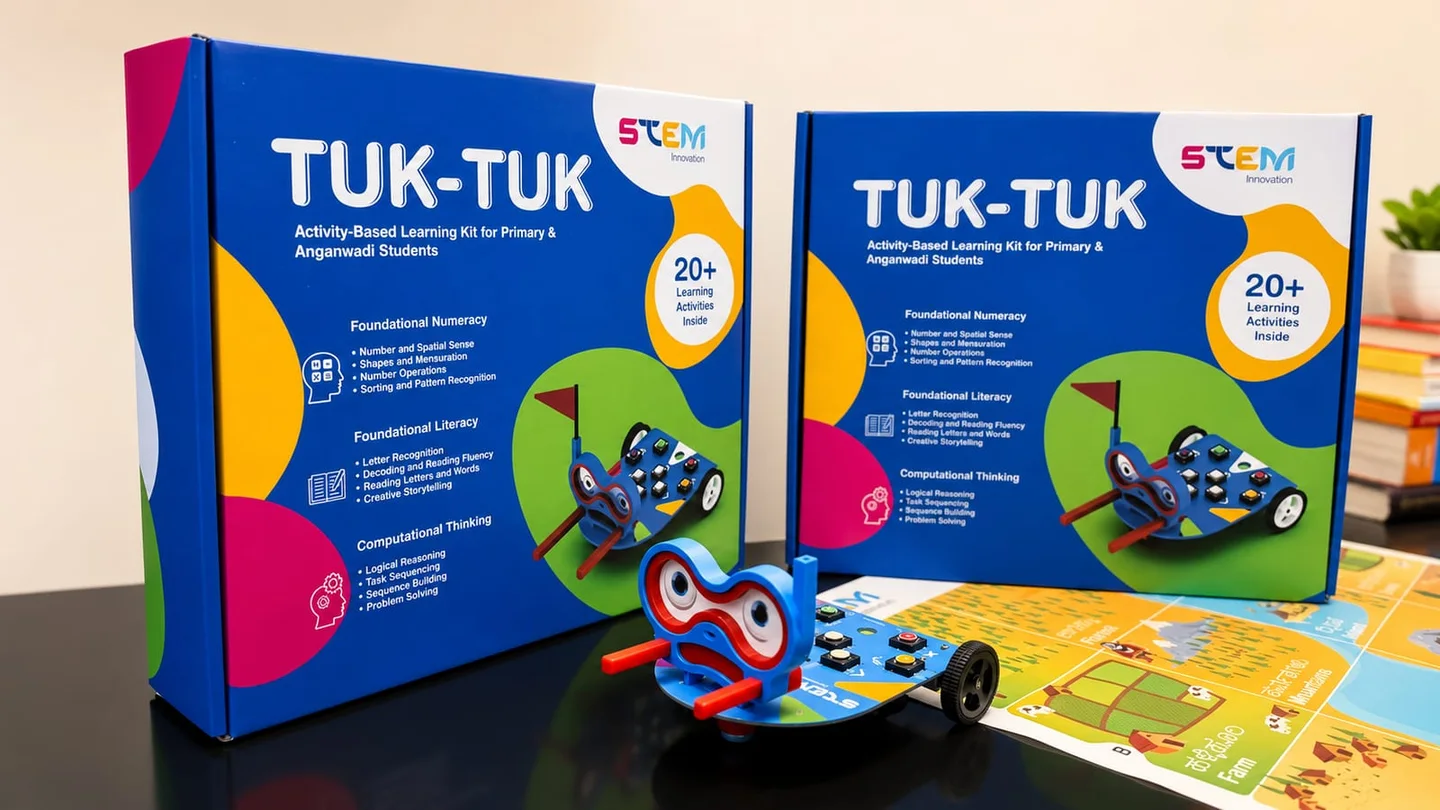
Overview
Computational thinking in an early-childhood activity can mean organising steps, predicting what will happen, observing a result and revising a plan. It does not require professional programming or a screen. Stories, block arrangements, movement games and suitable button-controlled robots can offer different ways to make these ideas concrete. Keep the task playful and understandable, and ask children to explain their choices rather than rewarding only a correct final answer.
Sequencing: put meaningful steps in order
Use familiar routines or story pictures to discuss what happens first and next. Ask why the order matters. Allow a child to try an alternative and talk about its result when appropriate. This gives sequencing a meaning beyond memorising a row of symbols. With TUK-TUK, a short direction sequence provides a physical example of ordered instructions; the adult still supplies the learning context.
Prediction: explain an expectation before trying
Invite children to point to a possible destination or describe what might happen. Accept more than one idea before the test. A prediction is useful because it gives the group something to compare with the result, not because every child must be right immediately. Keep the number of steps manageable and the starting position clear so that the challenge is understandable.
Revision: change one part and try again
When an arrangement or route differs from the plan, describe the difference neutrally. Ask which step could change and why. Testing one change at a time makes the effect easier to discuss. Avoid presenting this as a race or a failure; the useful experience is observing and explaining. The word debugging can describe correcting a sequence, but it need not turn the activity into a formal programming lesson.
Example without a robot: build and explain a path
Use suitable blocks or floor markers to make a short route to a target. One child describes the steps and a partner follows them under adult guidance. Compare the plan with the journey and revise one direction. Follow the centre's movement and material safety requirements. This example shows that sequencing and prediction are not exclusive to a purchased robot kit.
Example with TUK-TUK: predict a physical sequence
On a compatible mat, choose a nearby destination and ask a pair to agree directions. Enter the sequence with facilitator support, observe the movement and discuss any difference. Count moves or describe the target only when that matches the chosen learning goal. A reached destination alone does not show understanding; invite the children to explain what they would keep or change.
Offer more than one way to participate
Some children may explain orally, others may point, gesture or work with a partner. Rotate planning and observing roles as well as equipment handling. Simplify a sequence when needed and avoid making speed the measure of success. The educator should consider current product instructions and each child's support needs, not apply one fixed challenge to every learner.
Use curriculum context without an approval claim
The NCERT foundational-stage framework describes learning through play, interaction and exploration. These principles provide context for planning activities; they do not certify this product or prove a specific learning impact. Use local programme goals and educator judgement to choose suitable tasks, then record observations rather than inventing outcome percentages.
Plan literacy and numeracy activities
Educational context
Official guidance provides educational context, not approval or certification of this product.
- NCERT: National Curriculum Framework for the Foundational Stage (2022)
- Ministry of Education: NIPUN Bharat guidelines
Related learning guides
Planning an FLN or Anganwadi learning project?
Request a demonstration, current itemised contents and a written project quotation. Smart Anganwadi supplies and implements funded projects; it does not provide grants.
Request a Demo · Request Product Details
Smart Anganwadi™ is a tech-enabled Anganwadi implementation and execution partner operated by Arihant Enterprises, Thaltej, Ahmedabad, Gujarat 380058, India | info@smartanganwadi.com | +91 99982 43365. It is a private company, not a government department or scheme, and does not provide grants, funding, loans or any assistance or government financial support.